
individual support program for older adults
Are you experiencing symptoms of anxiety, depression, or bipolar disorder?
You are not alone!

Solutions and tools exist to help you feel better and live a fulfilling life.
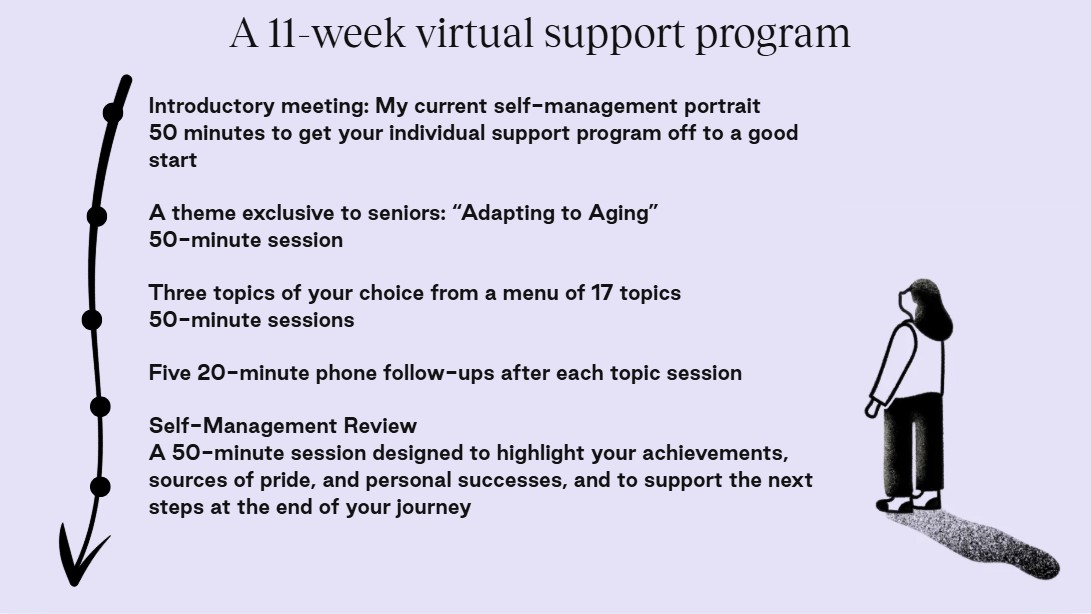
LIMITED SPOTS ♦ LIMITED-TIME OFFER
Take advantage of an exceptional subsidized rate of $180 for the complete individual self-management support program offered by Relief. (only $30 for each topic session)

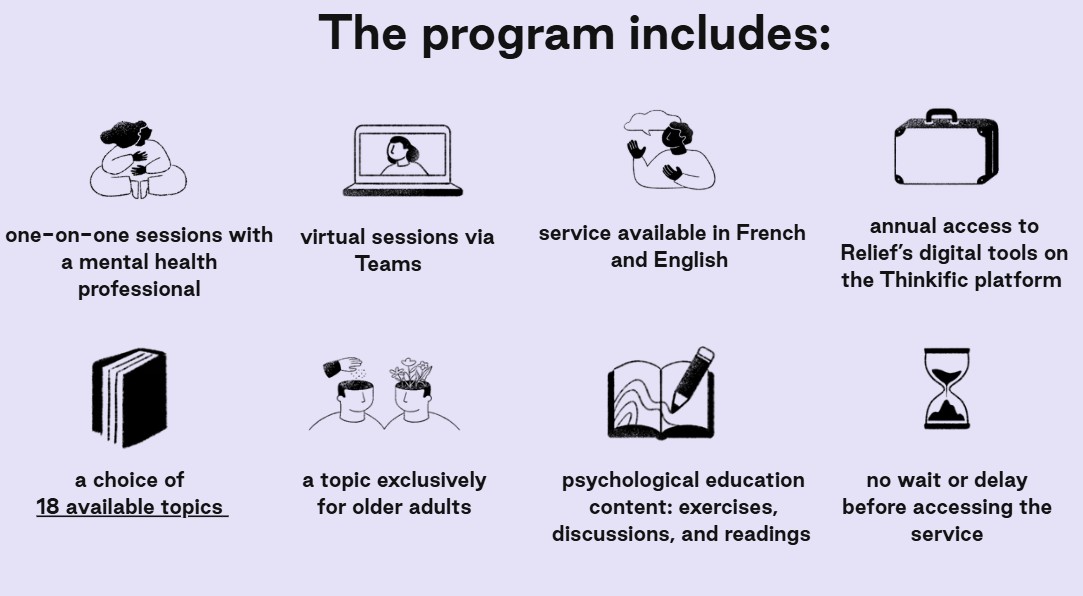
a dedicated topic for older adults
What does the topic dedicated to older adults cover?

- The aging process and the life course
- Coping mechanisms and stress related to life transitions
- The stages of grief
- Physical, cognitive, and social changes
- Life-changing events associated with this stage of life
explore the 18 topics
according to what you are experiencing
welcoming and accepting experiences
Acceptance is defined as consenting to experience psychological events (thoughts, feelings, sensations and memories) without avoiding them or allowing them to exert undue influence over our behaviour. It is therefore the opposite of avoidance.
Acceptance does not mean that you want to experience unpleasant sensations. When you welcome them, you don’t fight the manifestations; you let them be so that they don’t control you.
behavioural activation
Behavioural activation is a therapeutic approach that focuses on taking action to promote the pleasurable experiences associated with actively participating in activities and decreasing behaviours that maintain negative affects.
In other words, behavioural activation aims to counteract passive avoidance of unpleasant situations by proactively engaging in activities that make you feel good, regardless of your mood or motivation level in the moment.
comforting activities and anchoring
Sometimes, our hectic lives and many responsibilities overwhelm us, and without even realizing it, we start spending less time on activities that make us feel good. In other cases, living with symptoms of anxiety or depression can cause us to lose interest or to feel very distant from activities that used to help our well-being.
However, engaging in activities primarily aimed at self-care can positively affect us, and should not be neglected. You may need support to take stock of these comforting activities and help you implement them on a daily basis!
assertiveness and communication
Assertiveness can be described as an external manifestation of your self-esteem. Being adequately assertive means being able to express your needs, ideas and values without resorting to aggression or submission.
Healthy assertiveness is being able to express yourself and defend your rights without encroaching on those of others. It is an attitude of healthy firmness in relation to people and events.
self-compassion
According to Kristin Neff, the researcher who pioneered this concept, self-compassion is an attitude of being kind and understanding toward ourselves in difficult times. It is not synonymous with complacency or self-pity, but an active posture associated with emotional well-being. Self-compassion allows you to soften your language toward yourself.
mental filters that influence our thinking
Each of us has filters, also known as cognitive distortions. These are automatic thoughts that come to you when you have symptoms of anxiety or depression, and skew your perception of reality. It has been shown that the way we understand and interpret situations influences how we feel and react. Hence the importance of being aware of the presence of your filters so as to be able to nuance or influence their impact on you (emotions, moods, actions and reactions) and on others.
stress management
Stress management is one of the tools you need in order to maintain balance in your daily life. In this topic, you’ll explore tools that will help you learn to better cope with stress on a daily basis.
lifestyle habits
Healthy lifestyle habits help to maintain mental well-being and contribute to a healthy life balance. In this topic, you will explore diet, sleep, physical exercise, and alcohol and drug use. This is an area over which you can have a great deal of power to act... although this is often easier said than done, especially at first.
Changing your lifestyle habits won’t produce miracles, but a healthy lifestyle will predispose you to better managing your anxiety or depression symptoms. This can be difficult in the beginning, given the repeated effort it requires on your part and the difficulty of shedding familiar and sometimes entrenched ways of doing things.
anxiety and mood diary and introduction to warning signs
This topic helps you assess fluctuations in your mood and anxiety on a daily basis. It covers concrete tools to help you better understand yourself and identify warning signs and avoid relapse.
functional cycle you may encounter at work
This topic will explore functional cycles at work as well as potential solutions and strategies that you can apply to manage the impact of your mental health on your work or vice versa.
your support network and breaking out of isolation
This topic will help you identify the people around you who provide you with professional or personal support. Family members are often the first people that spring to mind, but don’t forget your friends, colleagues, people from the community, neighbours, etc. who can all strengthen your network.
mindfulness and relaxation
While mindfulness is based on Buddhist teachings, it is neither religious nor esoteric. Practising mindfulness is a unique way to experience the present moment—deliberately and without value judgments.
Anyone can work brief mindfulness and relaxation exercises into their daily lives. This topic is an occasion to discover or deepen your experience of mindfulness and relaxation.
emotion regulation
This topic is an invitation to identify the emotions that make up your inner landscape. You’ll be able to recognize the strategies you already use to take care of your emotions, observe them, and become aware of their functioning in your daily life. You will also learn new strategies to regulate certain emotions more effectively.
problem-solving
Everyday problem-solving can be a source of worry and anxiety. The problem-solving strategy we will look at will help you focus on your issues and resolve them more effectively, even when you feel less able to find solutions. The method involves breaking the process down into small steps and should help you work toward an appropriate solution more effectively by taking a step back to focus on the problem at hand and structure your thought process.
types of support and relationships with loved ones
Relationships with others are part of what defines us as individuals. In a way, relationships reflect a part of what we are, and the choices we make. Our self-esteem evolves through relationships with others; our ups and downs are partly shaped by others. This topic will help you identify the different types of support and recognize how each person in your network can help you.
personal values, choices and priorities
It’s not always easy to identify the values that guide our actions, choices and priorities. This topic will help get you thinking and enable you to analyze your needs according to your tastes, preferences and interests before making your decisions.
recovering energy in an entrepreneurial context
This content explores how entrepreneurial stressors can drain both physical and psychological energy. It highlights the importance of recognizing one’s resources and replenishing them through targeted activities. The goal of this topic is to help maintain well-being and vitality in order to better face daily challenges.
my self-management review
Individual self-management support culminates in a review session. This is a time to celebrate and take pride in everything you’ve achieved during your journey. It is also a time of reflection where you can observe and assess how far you’ve come and look ahead to support your next steps.
the benefits of the support program for older adults
- A turnkey service at your own pace
- Accessible, flexible, and personalized support
- Navigating life changes with new strategies: grief, personal transformations, and challenges related to aging
- Break through isolation and alleviate stress caused by anxiety, depression, and sleep disorders
- Improve your well-being and quality of life
- Promote your independence and ability to take action in daily life
- Discover self-management support
eligibility criteria
- Be 60 years of age or older.
- Live with daily symptoms of anxiety, depression, or bipolar disorder.
- Own a functional computer or tablet and be fully technologically independent.
- Know how to use technological tools (Teams and an online learning platform).
- Be committed to participating in an ongoing series of virtual one-on-one sessions.
- Actively engage in the process, including by participating in the activities offered during and between sessions (discussions, readings, exercises, practical applications).
- Participate in all sessions with your camera on (sessions are not recorded).
- Ensure a confidential and private environment (e.g., closed room, headphones if needed).
- Agree to the schedule for biweekly topic sessions at the same reserved time slot.
Relief offers you the opportunity to participate in this program
at a subsidized rate of $180 for 11 weeks
Ready to sign up?
Need more information?
Contact our team—we’ll answer all your questions!
*Limited-time offer. Subject to availability. No spots reserved.
acknowledgments
Relief’s specialized individual self-management support service for older adults is made possible thanks to the financial support of the Mirella and Lino Saputo Foundation.
Relief would like to thank the VIEsÂGE program for its collaboration in developing clinical content, creating the content dedicated to older adults, and training Relief’s clinical team.